
Indoor swimming pool cost guide
How Much Does an Indoor Swimming Pool Cost in the UK?
An indoor swimming pool is more than a pool placed inside a building. The pool structure, building envelope, heating, ventilation, dehumidification, insulation and moisture-resistant finishes must all operate as one coordinated system.
This independent guide explains realistic indoor swimming pool costs in the UK, what makes indoor projects more expensive than outdoor pools, and the areas homeowners should include in an early budget.
For a broader overview of outdoor, indoor and bespoke project prices, begin with our main guide to swimming pool costs in the UK .
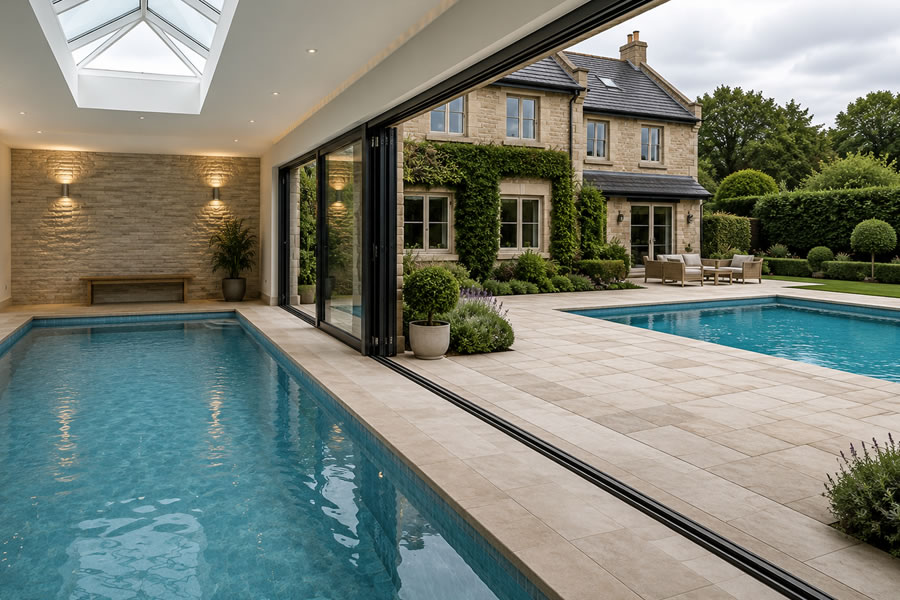
Indoor pool costs depend on the complete building project
A pool installed inside a suitable existing structure may cost substantially less than a project requiring a purpose-built extension or standalone pool house.
The final budget depends on the pool specification, building condition, construction access, ventilation design, heating, insulation, glazing, plant equipment and the standard of the surrounding interior.
Typical indoor swimming pool cost ranges in the UK
Indoor pool prices vary widely because the pool and its surrounding structure may be quoted separately. The following figures are broad editorial ranges intended for early project planning.
An indoor pool installed where the existing structure can be adapted without major rebuilding, subject to suitable access, foundations, ventilation and moisture-control requirements.
A bespoke pool with premium finishes, automatic cover, substantial mechanical services and extensive alteration to the surrounding space.
A complete building project incorporating the pool structure, foundations, glazing, insulation, climate control, plant room and internal finishes.
A highly bespoke project involving complex architecture, extensive glazing, luxury interiors, specialist pool features or substantial integration with an existing property.
Why do indoor swimming pools cost more?
Outdoor pools require structural work, equipment, heating and finishes, but indoor pools add an entire controlled environment around the water. The surrounding building must withstand warm, humid conditions without developing condensation, corrosion, mould or damage to its finishes.
Purpose-designed building envelope
Walls, roof, insulation, vapour control, glazing and junctions must be designed for the conditions created by an indoor pool.
Ventilation and dehumidification
Mechanical systems are required to control moisture, maintain comfort and protect the fabric of the building.
Air and water heating
Indoor pools require coordinated control of both water temperature and the surrounding pool-room air.
Specialist internal finishes
Flooring, wall finishes, ceilings, doors and fittings must be appropriate for warm, humid and potentially corrosive conditions.
Pool building and structural costs
Where a dedicated pool building or extension is required, the structure may represent a major proportion of the total budget.
Costs can include foundations, structural walls, roof construction, insulation, glazing, external finishes, internal ceilings, drainage, electrical work and connections to the main property.
| Building element | Why it matters | Potential cost influence |
|---|---|---|
| Foundations | Must support the building and respond to ground conditions | Higher where soil, groundwater or access is difficult |
| Roof design | Influences insulation, ventilation and architectural character | Complex spans and glazing increase cost |
| Glazing | Provides light and connection with the garden | Large specialist units can be expensive |
| Insulation | Reduces heat loss and helps manage condensation risk | Higher-performance systems increase initial cost |
| Internal finishes | Must tolerate a humid pool environment | Premium stone, timber and specialist products add cost |
| Connection to the house | May involve structural openings and alteration work | Greater where the existing property is complex or historic |
Indoor pool construction costs
The pool itself may be built using concrete, block-and-liner, prefabricated shell or another specialist system.
Concrete construction usually offers the greatest freedom over shape, depth, steps and finishes, but often requires more time, skilled labour and on-site work.
Prefabricated systems can shorten the installation period, although delivery access, cranage and the available range of sizes must be considered before the building is designed around them.
Design the building and pool together
Selecting a pool system before considering access, plant-room space, ventilation routes and the structural design of the building can create expensive revisions later. The pool and its enclosure should be planned as one coordinated project.
Read our broader guide to swimming pool installation in the UK for the full construction journey.
Ventilation and dehumidification costs
Water continuously evaporates from an indoor pool surface. Without suitable environmental control, the resulting moisture can condense on glazing, walls, roofs and colder parts of the building.
A properly designed system may combine air circulation, dehumidification, heat recovery and air heating. Its size and cost depend on pool area, water temperature, expected use, cover arrangement, room volume, glazing and the required internal conditions.
A domestic extractor fan is not a pool climate-control system
Indoor pool environments require specialist assessment. Inadequate moisture control can lead to condensation, damaged finishes, corrosion and expensive building repairs.
Duct routes, plant access, external grilles, noise management and future servicing requirements should all be included during the architectural design stage.
Heating and insulation costs
An indoor pool commonly requires separate consideration of water heating, pool-room air temperature and heat loss through the surrounding structure.
The heating system may use a heat pump, boiler, heat exchanger, renewable energy source or a combination of technologies. The correct choice depends on usage, desired temperature, building performance and available utilities.
Insulation and vapour control are equally important. Better thermal performance may add to the construction budget but can reduce future heat demand and improve comfort.
- Pool-water heating system
- Air heating for the pool hall
- Heat-recovery equipment
- Wall and roof insulation
- Insulated glazing
- Insulation around pool pipework
- Pool-shell insulation where appropriate
- Heat-retaining pool cover
- Controls and monitoring
- Energy-supply upgrades
Ongoing heating and climate-control expenses are covered separately in our guide to swimming pool running costs in the UK .
Plant-room and equipment costs
An indoor pool requires sufficient space for filtration, circulation, treatment, heating and control equipment. Climate-control machinery may also need dedicated plant space.
A poorly positioned or undersized plant room can make servicing difficult, increase pipe runs and restrict future equipment replacement.
Filtration system
Includes circulation pumps, filters, valves, pipework and controls required to move and clean the pool water.
Water treatment
May include automatic dosing, sanitation equipment, monitoring systems and safe chemical-storage arrangements.
Heating equipment
Requires appropriate capacity, connections, controls and space for inspection and maintenance.
Climate-control plant
Dehumidification, ventilation and heat-recovery systems may require significant space and carefully designed ductwork.
Interior finishes and luxury features
Indoor pools are often integrated with changing rooms, showers, saunas, gyms, relaxation spaces and large glazed openings. These elements can significantly increase the project budget.
| Feature | Cost consideration | Questions to ask |
|---|---|---|
| Pool tiling | Material, detailing and labour vary widely | What maintenance and warranty apply? |
| Pool surround | Slip resistance and moisture suitability are essential | Is the material appropriate for wet barefoot use? |
| Automatic cover | Requires mechanism, housing, controls and access | Can it be serviced without major disruption? |
| Large glazing | Structural and thermal performance affect price | How will condensation be controlled? |
| Sauna or steam room | Adds specialist construction and building services | Are ventilation and drainage included? |
| Movable floor | Highly specialised engineering and controls | What servicing and maintenance are required? |
Converting an existing building versus constructing a new pool house
Converting a barn, basement, garage or outbuilding may appear less expensive than creating a new structure, but suitability cannot be assumed.
The existing building must be assessed for structural capacity, foundations, ceiling height, access, insulation, moisture control, ventilation routes and the space required for pool equipment.
| Approach | Potential advantage | Potential difficulty |
|---|---|---|
| Existing outbuilding | May retain an attractive existing structure | Substantial upgrading may be needed |
| Basement conversion | Can create a highly private pool environment | Access, excavation and waterproofing can be complex |
| New extension | Can connect directly with the main property | May involve structural alteration and planning work |
| Standalone pool house | Allows the building to be designed around the pool | Requires complete services, access and landscaping |
The cheapest-looking starting point is not always the cheapest project
A poor-quality existing structure may require extensive reinforcement, insulation, replacement roofing, new floors and specialist ventilation. A purpose-designed new building can sometimes offer greater certainty and better long-term performance.
Professional, planning and approval costs
Indoor pool projects often require input from several professionals because they combine structural construction, architecture, mechanical systems and specialist pool engineering.
- Architectural design
- Structural engineering
- Mechanical-services design
- Ventilation and humidity-control design
- Energy and insulation assessment
- Ground investigation
- Drainage design
- Planning application work
- Building-control involvement
- Listed-building or heritage advice
- Interior design
- Project management
Planning requirements depend on the property, location, building size and nature of the proposed development.
Read our guide to planning permission for swimming pools before assuming that a building or conversion can proceed without formal approval.
How to prepare an indoor pool budget
Divide the project into clear cost groups so that expensive omissions are easier to identify.
Pool and equipment
Pool structure, finish, filtration, heating, water treatment, lighting, cover, controls and commissioning.
Building and environment
Structure, insulation, glazing, ventilation, dehumidification, air heating, flooring and moisture-resistant finishes.
Professional and surrounding work
Design fees, approvals, drainage, electrical work, access, landscaping, changing facilities and project contingency.
Ask the project team to identify assumptions, provisional sums and exclusions before work begins. A lower quotation may simply cover a narrower scope.
Indoor swimming pool cost FAQs
How much does it cost to build an indoor pool in the UK?
A substantial indoor pool project may begin within the lower six-figure range, while complete architectural pool houses can cost several hundred thousand pounds. The surrounding building and climate systems often represent a large part of the total.
Can an existing outbuilding be converted into an indoor pool?
Potentially, but the structure must be assessed for foundations, access, ceiling height, insulation, moisture control, ventilation, drainage and plant-room space.
Why does an indoor pool need dehumidification?
Moisture continually evaporates from the pool. Dehumidification and ventilation help control humidity, reduce condensation and protect the building fabric.
Is the indoor pool building included in an installer’s quotation?
Not necessarily. Some pool companies quote for the pool and specialist equipment only, while the building is designed and constructed by separate professionals and contractors.
Is an indoor pool cheaper to run than an outdoor pool?
Not automatically. Indoor pools avoid direct exposure to outdoor weather but require air heating, ventilation and humidity control. Running costs depend on design, temperature, cover use and efficiency.
Does an indoor pool need planning permission?
The answer depends on the property, proposed building, location and development rights. Extensions, standalone buildings and conversions should be checked before work begins.